What if the cheapest DeFi transaction is not the one with the lowest displayed gas fee? That question changes how we should think about wallet management. A swap that saves a few dollars today may create a lingering token approval, expose funds to a compromised contract, or encourage a rushed signing decision later. Conversely, tightening every approval and rejecting every unfamiliar transaction can make a wallet safer in theory while making ordinary DeFi activity needlessly expensive and difficult.
For users in the United States who are downloading and installing the Rabby browser extension, the useful goal is not simply “minimize gas.” It is to optimize the full cost of operating a wallet: network fees, approval risk, time, complexity, and the possibility of an irreversible mistake. These costs interact. A sound approach treats gas management, token permissions, and transaction review as one system rather than three separate chores.
Why DeFi users still pay for old assumptions
Early Ethereum users often thought of a transaction as a single event: choose an action, pay gas, and wait for confirmation. DeFi made that model incomplete. A typical token swap may involve an approval transaction first, followed by the swap itself. Lending, staking, liquidity provision, and vault strategies can add more contracts and more permissions. The wallet is no longer just moving assets; it is authorizing software to act on the wallet’s behalf.
This distinction matters because an approval is usually not the same as a transfer. For an ERC-20 token, an approval can allow a specified spender contract to move a specified amount of that token from the user’s address. If the approval is set to a very large amount, the user may not need to approve that token again for every future interaction with the same spender. That can save gas and friction. But the permission can remain active after the original transaction, including when the user has stopped using the protocol.
The common misconception is that an approval itself drains a wallet. It does not automatically do so. The danger arises when a spender has excessive permission and later becomes malicious, compromised, or unsafe to interact with. The risk also increases when a user signs an approval for the wrong contract because a phishing site, misleading interface, or look-alike token created confusion. Security is therefore not only about whether the transaction succeeds; it is about what authority the transaction creates afterward.
Two approval strategies: maximum convenience or narrow permission?
Unlimited approvals
Unlimited, or effectively very large, approvals are designed for convenience. Once approved, a user can often make repeated trades or deposits without paying for a separate approval transaction each time. On a busy network, avoiding one extra transaction can be meaningful. On Ethereum mainnet, where demand can make fees volatile, the savings may be more noticeable than on a lower-cost network.
The trade-off is persistence. A large approval can outlive a particular position, a browser session, or even the user’s memory of having used the protocol. If a contract’s security assumptions change, the permission may remain relevant. This does not mean every unlimited approval is reckless; established protocols may use them because repeated approvals create user friction and additional gas costs. It means the convenience is purchased with a larger permission surface.
Exact or limited approvals
Exact approvals authorize only the amount needed for a particular action, or a deliberately chosen allowance close to the user’s expected usage. Their main advantage is containment. If something goes wrong with the spender, the amount available through that approval is lower. Limited approvals are especially sensible when testing a new protocol, interacting with a small or unfamiliar application, or handling assets whose loss would be unacceptable.
The cost is not merely the extra gas. A limited allowance may require another approval later, which means another transaction to inspect and sign. Users who repeatedly approve small amounts can also become habituated to clicking through prompts. That creates an important boundary condition: a smaller allowance does not help if the user stops reading the spender, chain, token, or requested function because approvals have become routine.
A practical comparison is therefore less about choosing one universal rule and more about matching permission size to exposure. For a one-time interaction with an unfamiliar contract, a narrow approval is usually easier to justify. For repeated use of a protocol that the user understands and monitors, a larger allowance may be a reasonable convenience trade-off. The decision should reflect both the contract’s trust assumptions and the value being exposed.
Gas optimization: reduce waste without reducing understanding
Gas is the computational fee paid to have a blockchain execute and record an operation. On Ethereum and other networks that use dynamic fee markets, the final cost depends on network demand, the transaction’s computational complexity, and the fee settings selected by the wallet. A higher gas price can improve the chance of timely inclusion, but it does not make a smart contract safer or reverse a bad transaction.
The first gas-saving comparison is batching versus separate actions. If a protocol supports a reliable multicall or bundled workflow, combining related actions can reduce repeated overhead and the number of signatures. The limitation is that a more complex transaction can be harder to understand and may involve more contract calls. A single approval followed by a swap is not automatically safer than two clearly reviewed transactions merely because it uses fewer clicks.
The second comparison is timing versus urgency. Waiting for less congested periods may reduce the fee paid for a transaction, particularly on a busy mainnet. But an attempt to save gas can fail when the user delays a position adjustment, misses a time-sensitive opportunity, or submits an underpriced transaction that remains pending. “Set the lowest possible fee” is not a strategy; it is a gamble unless the user understands the network and the consequences of delay.
Network choice introduces another trade-off. Layer 2 networks and other lower-cost environments can make small trades and repeated approvals more economical, but moving assets between networks introduces bridge, liquidity, and operational risks. A cheap transaction on the wrong chain is not an efficient transaction. Before signing, confirm the active network, the asset’s chain, and whether the intended protocol actually operates there.
Wallet settings can help users make these choices, but they cannot remove the underlying uncertainty. Transaction previews, simulation results, fee estimates, and warnings are decision aids, not guarantees. A simulation may not capture every future state change, oracle problem, front-running condition, or contract vulnerability. The right mental model is an aircraft cockpit: useful instruments improve judgment, but they do not turn a risky route into a risk-free one.
Manual review versus wallet-assisted review
Advanced users sometimes inspect contract calls directly, use block explorers, or check allowance records through separate tools. This offers depth and independence, but it is time-consuming and vulnerable to human error. Contract data is difficult to interpret, and a familiar-looking address can still be the wrong address on the wrong network. Manual review works best when the user has the technical knowledge and patience to follow the entire call path.
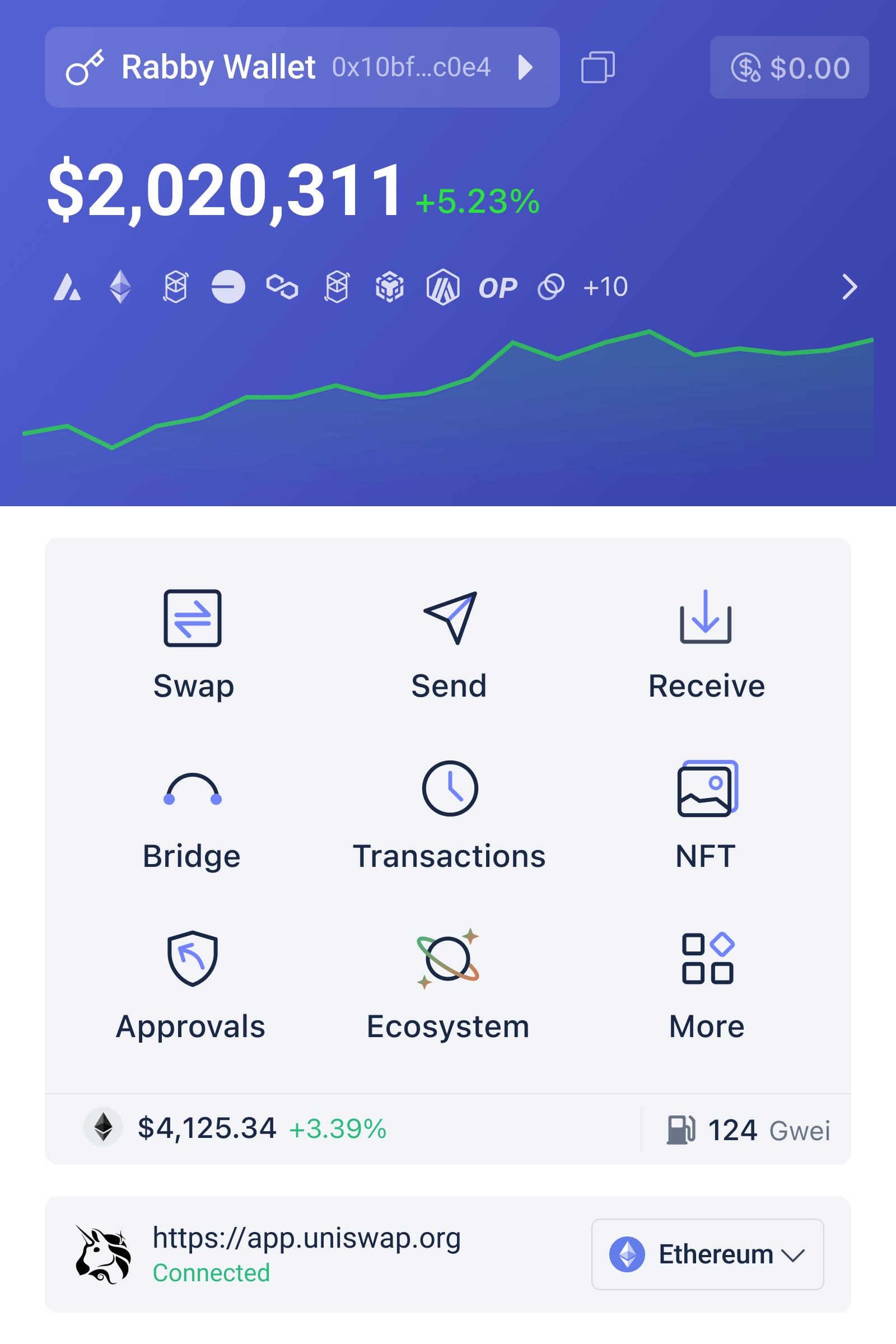
Wallet-assisted review provides a different balance. A browser wallet can place network, account, fee, approval, and contract information in the signing workflow. For someone installing Rabby, the rabby extension download should be treated as the beginning of a verification routine, not the end of one: install from a trusted source, create or import an account carefully, protect the recovery phrase offline, and test with a small amount before increasing exposure.
Assisted warnings are most useful when they change behavior. Before signing, ask what token is being spent, which contract is receiving permission, whether the amount is reasonable, and whether the transaction is an approval, a swap, a permit, a transfer, or a more complex interaction. If the wallet displays a simulation or risk signal, investigate an unexpected result instead of treating the warning as a nuisance. A warning that is always dismissed becomes decoration.
There is also a security distinction between the wallet interface and the key. A browser extension can help interpret transactions, but it does not make a seed phrase safe if the phrase is stored in cloud notes, entered into an unsolicited website, or shared with support impersonators. For larger balances, a hardware wallet can reduce exposure of the signing key, although it does not protect against approving a malicious contract. Hardware protects key custody; careful transaction interpretation protects authorization decisions. They solve related but different problems.
A reusable framework for everyday DeFi decisions
Before approving or signing, classify the action along four dimensions: value, permission, reversibility, and urgency. Value asks how much could be lost. Permission asks whether the action merely moves funds once or grants a contract continuing authority. Reversibility asks whether the transaction can be undone; most confirmed blockchain transactions cannot. Urgency asks what happens if the user waits ten minutes, an hour, or until fees fall.
This framework produces more useful choices than a blanket rule such as “always use unlimited approvals” or “never approve anything.” A small, reversible-looking swap may still contain a dangerous approval. A large transaction may be relatively straightforward if it sends a known asset to a verified address, although address mistakes remain irreversible. The relevant question is not simply how much gas costs; it is what future state the transaction creates.
After using a protocol, review active allowances periodically. Revoking an approval is itself an on-chain transaction and therefore costs gas. Revoking every allowance immediately may be expensive and can create a false sense of security if the user later reconnects to the same unsafe application. A more rational process prioritizes permissions that are unused, unusually broad, tied to unfamiliar spenders, or associated with assets the user no longer holds or intends to use.
One subtle point is that revocation is not a universal cleanup button. It generally changes an allowance for a particular token and spender on a particular network. It does not erase a signed transaction already executed, recover assets sent to the wrong address, or repair a compromised private key. It may also not cover every authorization design used in modern applications. Users should identify what kind of permission they granted rather than assuming that one allowance screen represents the entire security picture.
What may matter next
The direction of wallet design is likely to depend on whether interfaces can make complex permissions understandable without encouraging blind approval. Better simulations, clearer spender identity, allowance summaries, and more useful explanations could reduce mistakes. The conditional implication is straightforward: if these tools become accurate enough to fit ordinary workflows, users may make fewer unnecessary approvals and detect more suspicious transactions before signing. If alerts remain vague or overly frequent, users may learn to ignore them.
Account abstraction and related smart-account designs may also change how users manage gas and permissions. In principle, they can support sponsored fees, spending limits, or more programmable authorization. But programmability creates its own complexity. A policy that limits one type of action may not cover another, and a sponsored transaction may shift costs rather than eliminate them. The signal to watch is not the presence of a new wallet feature; it is whether the feature makes authority more bounded, visible, and recoverable.
For now, the strongest practice is deliberately unglamorous. Optimize gas when the savings are meaningful, but do not trade away comprehension. Prefer narrow approvals when testing or when exposure is high. Use larger allowances only when the convenience is understood and the spender is one the user is prepared to monitor. Treat every signing prompt as a description of future authority, not a routine confirmation.
Frequently asked questions
Are unlimited token approvals always unsafe?
No. They are a convenience mechanism that can reduce repeated approval transactions, but they create broader and longer-lasting permission. The appropriate choice depends on the protocol, the asset value, how often the user interacts with it, and whether the allowance will be monitored. Limited approvals reduce potential exposure but do not replace careful review.
Does revoking an approval recover tokens?
No. Revoking changes a token allowance so the spender can no longer use that allowance under the relevant contract rules. It does not reverse a completed transfer, recover funds sent to a wrong address, or undo a prior exploit. Revocation is preventive maintenance, not a refund process.
What is the safest way to reduce gas costs?
Start by avoiding unnecessary transactions and choosing an appropriate network for the application and asset. Compare the cost of an approval, the intended action, and any future interaction rather than focusing only on the current fee estimate. Do not lower fees so aggressively that a time-sensitive transaction becomes unreliable, and never accept a transaction you do not understand merely because it is cheap.
Can a secure wallet prevent every DeFi loss?
No. A wallet can improve key protection, transaction visibility, and permission awareness, but it cannot eliminate smart-contract bugs, bridge failures, phishing, market losses, or user error. Security is layered: protect the recovery phrase, verify the network and destination, inspect approvals, use appropriate custody for the amount at risk, and treat simulations and warnings as helpful evidence rather than absolute guarantees.